
Reviewed · ANURADHAPURA TOURS
Delve Into Ancient Anuradhapura with Optional Visit to Mihintale
Anuradhapura is easiest to appreciate when someone explains what you are looking at. This private tour links quiet monastic ruins, enormous stupas, sacred trees, royal gardens, and clever ancient plumbing into one well-paced route. Lucky, the guide named in the tour details, is known for giving clear explanations and answering plenty of questions.
I like the way this tour reaches beyond the headline monuments to places such as Vessagiriya, the Sakwala Chakraya, Janthagara, and the Abhayagiri refectory. I also like the private format: your group can ask questions, slow down at an important carving, or keep moving when a site has less appeal.
The main drawback is the price structure. The advertised $30 covers the guided experience, but the UNESCO site admission is another $30 per person, and private transportation is not included. You also need to meet at Pothanagama Junction and arrange your own way there.
Key points to know before you book
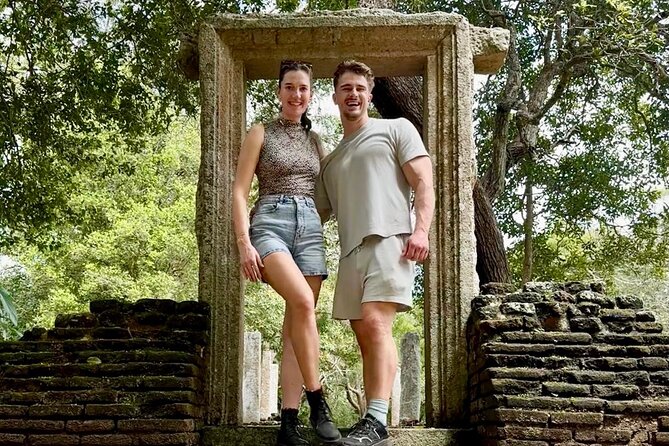
- Vessagiriya sets the tone: Begin among old forest-monastery ruins rather than jumping straight to the largest stupa.
- The route mixes famous and overlooked sites: You see Sri Maha Bodhi and Ruwanwelisaya, but also ancient baths, refectories, and carved guardstones.
- A private guide adds real value: Lucky can explain Buddhist practice, royal planning, stone art, and water systems while you move between sites.
- The ancient engineering is a highlight: Kuttam Pokuna, Eth Pokuna, and the steam-bath building show that Anuradhapura was more than a collection of temples.
- The $30 headline price is not the full cost: Add the $30 admission fee per person, plus transport to and from the meeting point.
- Allow a full morning: The tour lasts about six hours, with the listed start window running from 7:30 AM to 10:30 AM.
Starting among the Vessagiriya forest ruins
The day begins at Vessagiriya Forest Monastery, described as one of the island’s two oldest Buddhist monk dwellings. That makes it a useful opening stop because you start with the setting of monastic life, not just grand monuments.
The site is tied to Rajarata, the old royal region often translated as the King’s County or Land of Kings. Here, the interest is in the relationship between rock, forest, and simple monastic spaces. The one-hour-thirty-minute allocation is the longest single stop on the route, so this is where Lucky can give you context before the day turns toward larger sacred buildings.
I would pay attention to how modest the remains may appear beside Anuradhapura’s huge stupas. That contrast matters. The city was supported by both monumental religious construction and quieter places where monks lived, studied, and practiced.
A few more Anuradhapura days worth a look
- Private City Day Tour in Anuradhapura
★ 5.0 · 383 reviews - Minneriya National Park Elephant Jeep Safari Private Tour
★ 5.0 · 68 reviews - Explore & Ride the history of anuradhapura with Vogel Tours
★ 5.0 · 62 reviews
The Sakwala Chakraya and the old royal garden
Next comes the Sakwala Chakraya, also called the Star Gate, at Ran Masu Uyana. The site lies beside a boulder face, between Tissa Wewa and Isurumuniya Rock Temple. It is a short stop, about 35 minutes, but it gives the tour an unusual archaeological detail rather than another conventional shrine.
The surrounding Ran Masu Uyana is identified as the Royal Goldfish Park. You can use this stop to think about how water, gardens, and royal spaces fitted into the city’s design. The Sakwala Chakraya itself has attracted plenty of speculation, so a guide is useful here. Ask Lucky to separate what is documented from what is simply suggested.
This is one of the places where a private tour helps. You are not just taking a quick photograph of a carved rock. You can ask why the feature matters, how it fits the nearby site, and what remains uncertain.
Sri Maha Bodhi, the spiritual center of the morning
Sri Maha Bodhi receives only about 20 minutes in the listed schedule, but its importance is far greater than the time suggests. The sacred fig tree is regarded as the first of Anuradhapura’s eight sacred places. It is also identified as a direct offshoot of the Bodhi tree associated with the Buddha’s awakening.
This is an active religious place, not simply an archaeological object. Dress and behavior should be respectful, and you should be ready for a more devotional atmosphere than at the abandoned ruins. The tour gives you a short visit, so listen closely to Lucky’s explanation and take a moment to notice the difference between a living place of worship and a silent stone complex.
I would not judge this stop by its 20-minute duration. The point is to understand why Anuradhapura remains important to Buddhism in Sri Lanka. The tree gives the ancient city a present-day focus.
Lovamahapaya and the great stupa of Ruwanwelisaya
Just north of the sacred Bodhi tree, Lovamahapaya is represented by rows of granite pillars. The building is also known as the Brazen Palace. In its original form, it served as a major structure near the sacred center, but what you see now is the surviving stone framework.
The scheduled visit is only 15 minutes. That is enough to see the scale of the columns and learn how much has disappeared, but do not expect a long exploration. This is a quick visual lesson in the size of the buildings that once filled the ancient capital.
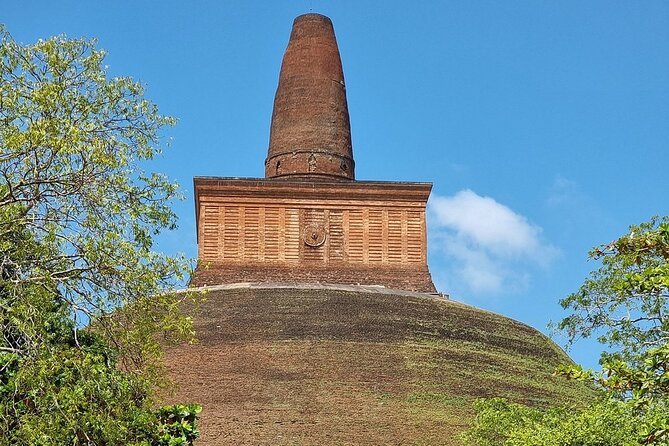
Ruwanwelisaya follows for about 25 minutes. Also called the Ratnamali or Mahathupa, this great stupa was built under King Gamini Abhaya in the second century BC. Its rounded white form is one of the defining sights of Anuradhapura.
The value of a guide here is not limited to dates. Lucky can help connect the monument to Buddhist worship, royal patronage, and the city’s role as a major center of religion. If you enjoy architecture, look at the stupa as a carefully planned structure rather than a single lump of masonry. If you prefer human stories, ask about the king and the purpose of building on such a grand scale.
Same base, a completely different kind of day out:
- Minneriya National Park | Private Safari
★ 5.0 · 59 reviews - Wilpattu National park – Morning or Afternoon Safari
★ 4.3 · 57 reviews - From Anuradhapura: All Inclusive Full Day Safari at Wilpattu
★ 4.4 · 50 reviews - Minneriya National Park Safari – Private Jeep with Hotel Pickup
★ 5.0 · 44 reviews
Gedige ruins and the practical side of monastic life
The route then moves toward the Mahapali Alms Hall, where you see the remains of several buildings. The largest is identified as the Mahapali Refectory, a place that supplied meals to Buddhist monks through royal support.
This 25-minute stop helps correct a common mistake. Ancient religious centers were not made only of shrines. They needed kitchens, dining spaces, storage, water systems, and staff. The ruins show the practical machinery behind religious life.
I find these supporting buildings especially useful for understanding the size of Anuradhapura. A refectory serving monks indicates an organized institution with dependable food supplies and a system of management. It also gives Lucky a chance to explain how the religious and royal sides of the city worked together.
Kuttam Pokuna and Anuradhapura’s water systems
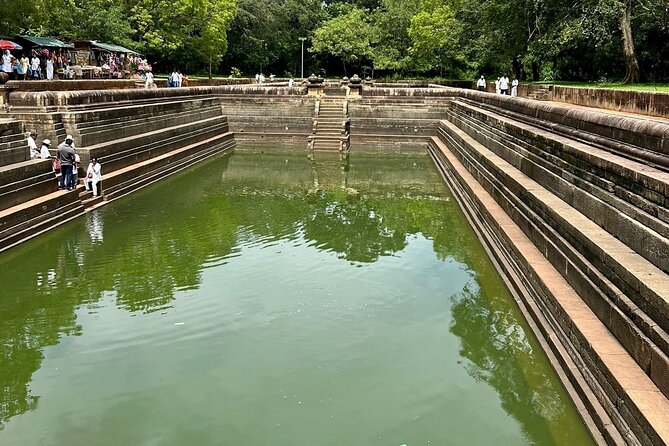
The Twin Baths, or Kuttam Pokuna, are allotted about 15 minutes. These two pools are described as fine examples of ancient planning and hydraulic work. They are among the clearest places on the route for seeing that Anuradhapura’s builders were solving practical problems with care.
The pools are more than attractive stone tanks. Their design reflects the importance of clean water and organized monastic life. You can ask Lucky to point out the features that make the baths notable, rather than simply treating them as a scenic pause.
The admission fee is listed as not included at this stop, which is worth remembering when working out your total cost. The same applies to several later sites. A $30 tour price can look low until you add the separate $30 UNESCO admission charge.
Janthagara, an ancient steam-bath building
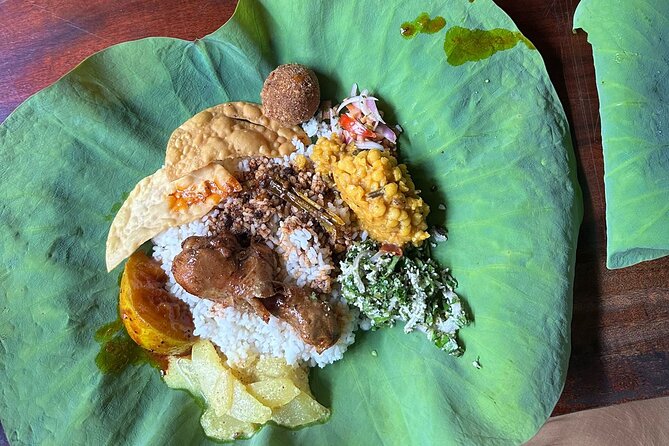
Janthagara is described as a steam-bath building connected with Sinhalese medical practice from the fourth century AD onward. The scheduled time is 15 minutes, so this is another compact stop, but it adds an unusual subject to the day.
The building was not simply for leisure bathing. The description connects it with warm water, steam, and a developed form of medicine. That makes it one of the more distinctive stops because it shows how health care fitted into the monastic setting.
This is the kind of place you could easily miss without a guide. The remains may not announce their purpose as clearly as a stupa does. Listen for the explanation of how the building functioned, and ask questions if you want more detail.
The Abhayagiri refectory and the giant stone trough
At the main refectory of Abhayagiri Monastery, you see a large granite trough shaped like a canoe. It sits in the refectory area and is linked in the description to the Chinese monk Fa-hsien, who studied at the monastery.
The stop lasts around 15 minutes. That may sound brief, but the trough itself gives you a strong picture of the scale of the monastic community. A stone vessel of this size points to organized food service on a large scale.
This is also one of the best places to ask about international links. The presence of a Chinese monk in the historical account reminds you that Anuradhapura was connected to a wider Buddhist world. The site is not just local archaeology. It was part of a network of study and pilgrimage.
Rathna Prasadaya and Sri Lankan stone carving
Rathna Prasadaya, or the Poya House, comes next, with about 10 minutes scheduled. The stop includes a guardstone and is dated to around the eighth century AD. The carved work is presented as an important example of Sri Lankan artistic skill.
A guardstone can look like a small detail beside a massive stupa, but it rewards close attention. These carvings helped mark entrances and gave architectural spaces a symbolic character. Use the short stop to look at the workmanship rather than rushing past for a wide photograph.
This is another point where a private guide can make a difference. Lucky can direct your eye toward the shapes and figures that may not be obvious at first glance. The visit is short, so you should not expect a long art lecture, but you can get a useful introduction to the city’s stone-carving tradition.
Eth Pokuna, the Elephant Pond
Eth Pokuna is known locally as the Elephant Pond. The description identifies it as a huge man-made pond built in the third century AD, located southwest of the refectory.
The 15-minute visit gives you a chance to see the scale of Anuradhapura’s water management from another angle. Kuttam Pokuna shows refined bathing pools. Eth Pokuna shows the need for a much larger water feature connected to a major monastic complex.
I like the way these stops balance one another. You do not see just one famous tank and move on. You see different kinds of water infrastructure, each connected to daily life, ritual, health, or institutional needs.
The moonstone and the final carved threshold
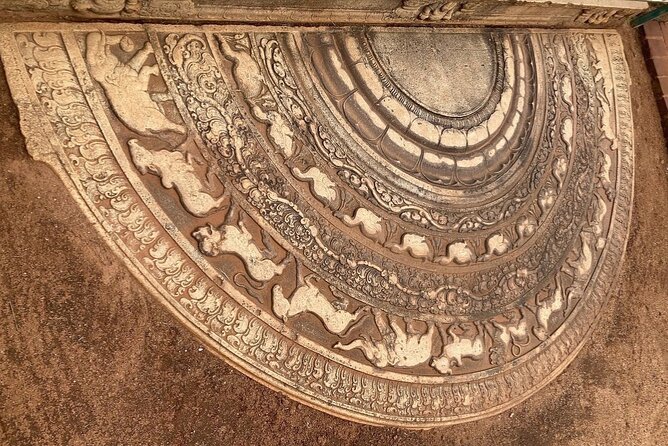
The tour ends with a moonstone, or Sandakada Pahana. These semicircular stones sit at the foot of steps leading to a Buddhist shrine. Their purpose may sound simple, but the carving turns an entrance into a carefully arranged work of art.
The moonstone is a fitting final stop because it brings the tour down to human scale. After huge stupas and enormous ponds, you finish by looking closely at the threshold beneath your feet. The carving carries the visual language of the ancient city into a single compact object.
The route includes many short stops, so the day can feel full. I would keep some attention for these smaller details instead of treating the largest monument as the only goal.
What the $30 price really covers
The listed cost is $30 per person. That pays for the private licensed guide, bottled water, and a king coconut soft drink or soda. You also receive a private experience for your own group, rather than joining a larger mixed party.
The major extra is the $30 per-person admission fee to the UNESCO World Heritage sites. Private transportation is also excluded. Since the meeting point is Pothanagama Junction, you need to arrange your own transport to the start and back after the tour.
For a private six-hour guided route, the guide fee can be reasonable, especially if you value explanation and the ability to ask questions. The value is less clear if you are mainly looking for transport, since you must organize that separately. Group discounts may help if you are traveling with several people, but the exact discount is not specified.
The tour includes bottled water and king coconut, a small but practical touch in Sri Lanka’s heat. Still, I would confirm the full expected cost before booking, including entry fees and your transport.
Timing, meeting point, and who should book
The activity meets at Pothanagama Junction on D S Senanayake Mawatha and ends back at that meeting point. The stated operating hours run Monday through Sunday, with a listed time window from 7:30 AM to 10:30 AM, while the experience itself lasts about six hours. Because those details do not perfectly explain the departure schedule, confirm your exact start time when booking.
Most people can participate, and the tour is near public transportation. It is a private activity, so only your group joins. That suits couples, families, and small groups who prefer direct conversation over a fixed commentary aimed at a busload of people.
The tour is best for you if you want the ancient capital explained in context. It is less suitable if you want a relaxed, unstructured morning or if you need private transport included. The route covers many sites, with some visits lasting only 10 or 15 minutes, so expect variety and steady movement.
Free cancellation is available up to 24 hours before the start time for a full refund. Cancellations or changes made inside that window are not refunded, and poor weather may lead to a new date or full refund.
Should you book this Anuradhapura tour?
Book it if you want more than the headline monuments. The strongest part of the experience is the range: Vessagiriya and the Star Gate, Sri Maha Bodhi and Ruwanwelisaya, ancient baths, refectories, medical facilities, waterworks, and carved thresholds all appear in one morning.
I would choose this tour for anyone who likes asking questions and wants a guide who can connect Buddhist practice with royal planning and everyday monastic life. The main caution is financial and practical: add the separate $30 admission fee, arrange your own transport, and confirm the start time.
If that total still fits your plan, this is a useful way to make sense of a very spread-out ancient city without missing its smaller and more revealing details.
FAQ
How long does the Anuradhapura tour last?
The experience lasts approximately six hours.
What time does the tour operate?
The listed operating hours are Monday through Sunday, from 7:30 AM to 10:30 AM. Confirm the exact departure time when booking because the tour itself lasts about six hours.
Where does the tour begin?
The meeting point is Pothanagama Junction, 2 Kanuwa Junction, D S Senanayake Mawatha, Anuradhapura.
Where does the tour end?
The activity ends back at the meeting point.
Is this a private tour?
Yes. Only your group participates in the activity.
Is transportation included?
No. Private transportation is not included, so you must arrange travel to and from the meeting point.
Is the entrance fee included?
No. Admission to the UNESCO World Heritage sites costs $30 per person and is listed separately from the tour price.
What does the tour price include?
The $30 price includes a professional licensed guide, bottled water, and soda or king coconut.
Who is the guide?
The guide is identified as Lucky, a professional licensed guide with Lucky Lanka Expedition.
Can I cancel for a full refund?
Yes, if you cancel at least 24 hours before the experience start time. Cancellations or changes made less than 24 hours in advance are not refunded.
Newly listed around Anuradhapura
- Day Tour Anuradhapura from Kandy by Lux Tours Lanka★ 4.5 · 5 reviews
- Wilpattu Half Day Safari From Anuradhapura★ 5.0 · 4 reviews
- Adventure safari Experience in Hurulu Eco Park, Sri Lanka★ 5.0 · 18 reviews
- One Day Tour – Sacred city of Anuradhapura & Sacred city of Mihintale. (Sunset)★ 4.5 · 23 reviews
- Kaudulla National Park Shared Safari★ 5.0 · 7 reviews
- Private Round Tour in Sri Lanka with Vehicle★ 5.0 · 6 reviews
- Minneriya National Park Half Day Elephant Safari★ 5.0 · 4 reviews
- Hurulu Eco Park Half Day Safari★ 5.0 · 18 reviews
Anuradhapura Tours, compared.
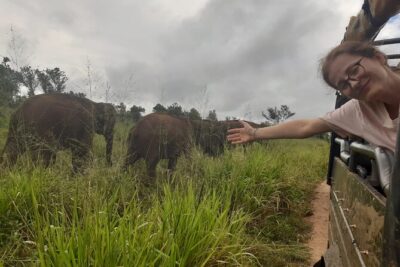
Minneriya National Park Elephant Jeep Safari Private Tour
Read our review →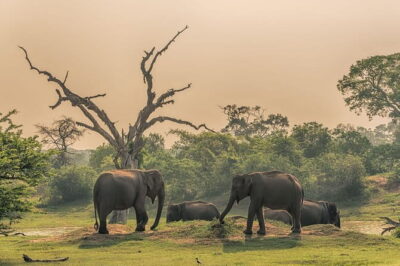
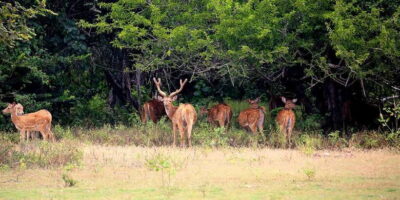
Wilpattu National park – Morning or Afternoon Safari
Read our review →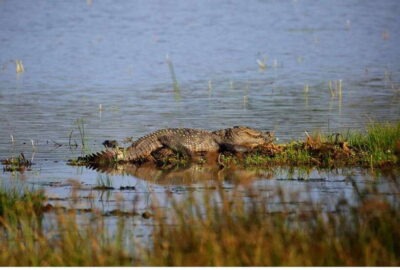
Minneriya National Park Safari – Private Jeep with Hotel Pickup
Read our review →
Minneriya National Park Safari [private , full package]
Read our review →
Browse the lists this tour appears in