

Reviewed · WALKING TOURS
Galle Fort Walk with Glamorous Stories
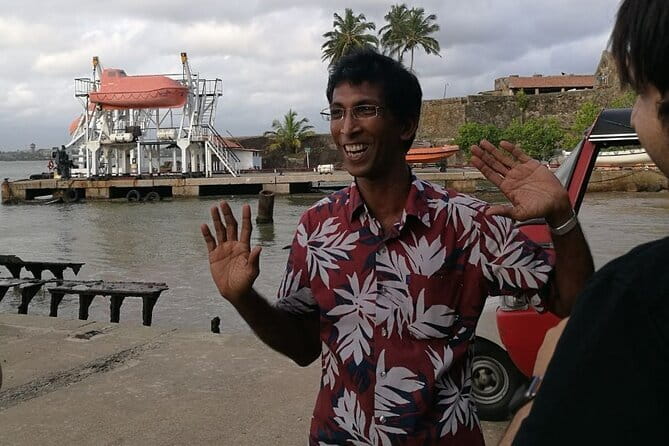
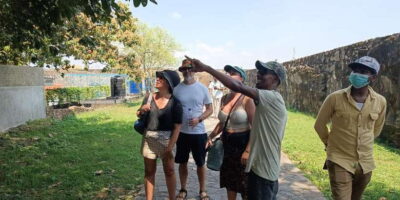
Galle Fort is more than a pretty wall by the sea. It is a compact history book built in coral, stone, and old brick, with stories of Chinese traders, Portuguese sieges, Dutch treaties, hidden tunnels, and a tsunami that destroyed much of Galle City but left the fort largely protected. This walk, led by local guide Dilip, gives those stories a clear human shape.
I like the small maximum group of six, which should make it easier to ask questions and keep the pace relaxed. I also like the mix of famous sights and odd details, from Dutch ballast bricks to soldiers surviving a siege by eating cats and dogs. The main drawback is that the walk offers no bottled water, umbrellas, hats, bicycle use, or private transport, so you need to arrive prepared.
Key points to know before you book
- A 90 to 120 minute history walk: The tour covers the major sights inside Galle Fort at an easy walking pace, with time for stories and questions.
- Dilip leads in English: He has lived in the Galle area all his life and focuses on local history, architecture, and folklore.
- A maximum of six people: The tour may be shared if several people book the same time slot, but it is not designed as a large coach group.
- The 2004 tsunami is part of the story: You learn how the fort walls shielded the old town while Galle City suffered major damage.
- Flag Rock is both start and finish: Arrange your ride back to your accommodation from the same meeting point.
- The price is $35 per person: That is fair for a small, guide-led walk, especially if you value context more than simply taking photographs.
Starting at Flag Rock and the old harbour
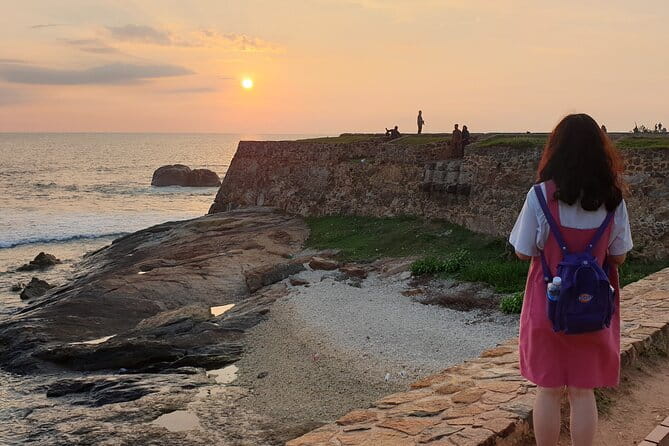
The walk begins at Flag Rock Bastion, a useful point for understanding Galle Fort before you enter its streets. The bastion sits at the fort’s seaward edge, where ships once approached and where flags helped signal activity in the harbour.
From here, Dilip sets up the larger story. Galle’s position made it a natural stopping point for Chinese, Arab, Portuguese, Dutch, and British traders. Cinnamon was a major prize, and the trade routes around it helped turn this corner of Sri Lanka into a place of repeated foreign competition.
You hear the story behind the local name Galla, along with the changing powers that controlled the port. These details matter because the fort was never built for decoration. Its walls, guns, stores, churches, and streets all served trade and military power.
The route returns to Flag Rock at the end, so you do not need to arrange a second meeting point inside the fort. Do remember that the walk finishes where it starts, not at your hotel or another part of Galle.
More Galle Fort Tours in Galle
- Galle Fort Walking tour
★ 4.9 · 285 reviews - Galle Fort Walking Tour with a Resident
★ 5.0 · 88 reviews - Galle Fort cooking class
★ 5.0 · 60 reviews
Portuguese forts, Dutch stone walls, and sharp political tricks
The fort’s story begins with the Portuguese, who built the first European defenses here. Their early fortifications used clay and earth before later construction replaced them with stronger stone walls.
The Portuguese period also supplies some of the tour’s most memorable tales. During one siege, soldiers reportedly survived for three months by eating cats and dogs. It is a grim story, but it shows how hard life inside a military fort could be when supplies failed.
Another tale concerns the building of Colombo Fort. The Portuguese are said to have tricked the local king by using a piece of leather to claim more land than expected. Stories like this give the political history a sly, personal edge. You are not just memorizing dates and rulers. You are seeing how deals, deception, trade, and force changed the map.
The Dutch later defeated the Portuguese and took control of Galle. Their own methods were not always gentle or honest. Dilip explains how the Dutch used two copies of treaties to cheat the local king, a reminder that European control depended on paperwork and negotiation as much as on cannons.
The walk treats the fort as a place shaped by several cultures, not as a simple Portuguese or Dutch monument. That is one of its strengths.
The three bastions and the fort’s defensive design
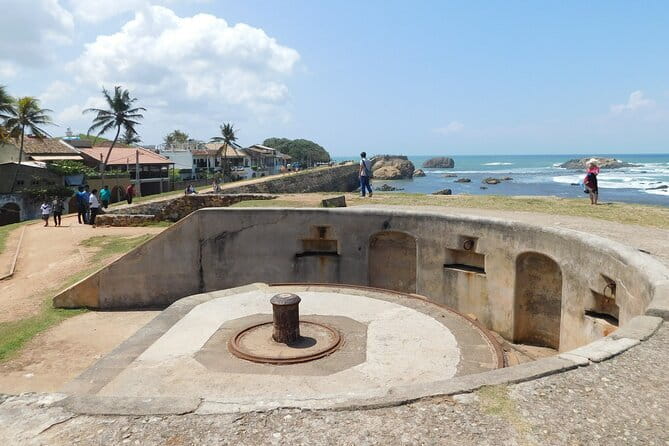
One of the main highlights is the front wall with its three bastions. These defensive platforms show how the fort was designed to control movement from land and sea.
You visit Moon Bastion and Star Bastion, along with other defensive points connected to the fort’s larger system. The names sound almost peaceful, but the purpose was practical. Bastions gave soldiers better positions for watching the coast and firing across likely approaches.
At Flag Rock, you see the remains of the old lighthouse and learn how the site helped guide ships. The setting is open and exposed, which makes it easier to understand why this edge of the fort mattered. It was a lookout, a signal point, and part of the port’s working life.
The walls also make the fort easy to picture as a defended town rather than a single military building. You move along broad outer sections, then turn into streets filled with homes, churches, shops, and restaurants. The change from hard military edge to lived-in town is one of the most interesting parts of the walk.
The ammunition store, tunnel, and practical fort life

The ammunition store is another useful stop because it takes you below the grand image of the fort. Here, the focus shifts to storage, movement, and the mechanics of defense.
The tour includes a tunnel connected with the ammunition store. You should not expect a long underground expedition, but the reference to hidden passages helps explain how supplies and people could move through the fort without always using the main streets.
Dilip also discusses coral cooling walls. This is a small architectural detail with a practical purpose. The fort was not only a military structure. It had to function as a place where people could live and work in Sri Lanka’s hot climate.
That kind of detail is where the walk earns its fee. You can see walls on your own, but a guide can explain why they were made in a certain way and how local materials were used. The fort becomes easier to read once you understand the link between climate, construction, and defense.
More Walking Tours in Galle
- Galle Fortt Guided Walking Tour with a Local
★ 4.9 · 33 reviews - Galle Fort Heritage Walk by a Certified Heritage Interpreter
★ 5.0 · 31 reviews - Galle Fort Walk with a Local
★ 4.5 · 7 reviews - Galle Fort Walking Tour with a local guide
★ 5.0 · 5 reviews
The Dutch Reformed Church and the human side of colonial rule

The Dutch Reformed Church, dated 1755, gives the route a quieter stop. Its origin is tied to a vow made for the birth of a child, adding a personal story to a building usually described through dates and architecture.
The church also helps explain how Dutch rule changed daily life inside the fort. European powers brought new religions, legal systems, building styles, trade practices, and social structures. The result was not a clean replacement of one culture by another. Galle developed through contact and mixture.
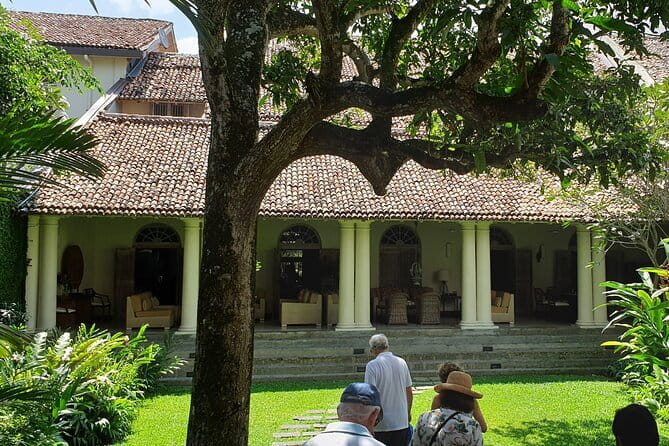
That cultural layering is visible in the streets around the church. The fort has Portuguese beginnings, Dutch military architecture, British-era changes, and local Sri Lankan life continuing through it all. Dilip’s focus on buildings lets you connect those periods instead of seeing them as separate chapters.
If architecture is your main reason for visiting, pay attention here and ask questions. The tour is not limited to famous façades. It explains how buildings fit into the political and social history of the fort.
Dutch ballast bricks and the cost of global trade
One of the more unusual details is the Dutch ballast brick. Ships needed heavy material to stay stable when they carried little cargo, and some of that material ended up in the fort.
These bricks offer a physical link between Galle’s walls and the ships that connected Sri Lanka to Europe and Asia. They are easy to overlook if you walk alone. With an explanation, they become evidence of how trade shaped even the materials used in construction.
The cinnamon story adds another layer. The old trade was dominated by Chinese merchants before Portuguese power pushed into the region. Later, the Dutch East India Company, known as the VOC, tightened control over trade and helped turn the fort into a center of commercial and military power.
The walk does not treat trade as an abstract subject. It ties business to the walls, warehouses, ships, treaties, and people who lived inside the fort. That makes the economic story easier to follow.
The Dutch Hospital and Galle Fort today

The Dutch Hospital is one of the clearest examples of old buildings being put to new use. Once connected with medical care, it now houses a selection of places to eat and drink.
This stop helps you see Galle Fort as a living district rather than a museum frozen in the past. You can look at the old structure, then consider how new investment has changed its role. The tour also discusses how foreign money is reshaping the fort and its heritage.
That subject deserves a balanced view. Investment can help preserve old buildings, keep streets active, and support businesses. It can also change the character of a historic neighborhood and make the area feel less local. This walk gives you a chance to think about that tension while you are looking at the buildings themselves.
The Dutch Hospital is also a practical orientation point. If you return later on your own, you will recognize it as one of the fort’s key public spaces.
The 2004 tsunami and the fort’s remarkable protection

The tsunami story is one of the most powerful parts of the walk. On December 26, 2004, waves devastated parts of Galle City, but the fort walls helped shield the old town from the worst of the destruction.
That does not mean the fort escaped every effect, but its survival shows how the original defensive design continued to matter centuries after it was built. The walls were made for war, yet they also became protection from a natural disaster.
Dilip connects the event to the physical setting, so you can see why the wall height, position, and heavy construction made such a difference. This is a strong example of history remaining useful in an unexpected way.
The tsunami section also changes the tone of the walk. Earlier stories concern rulers, soldiers, trade, and deception. Here, the focus turns to modern Galle and the strength of the old structure in the face of nature.
Timing, weather, and the pace of the walk
The experience runs for about one and a half to two hours. That is long enough to cover the major sites without turning the tour into an exhausting half-day commitment.
The advertised hours are 8:30 a.m. to 6 p.m., Monday through Sunday, for the current operating period. An early start can make the walk more comfortable, while an evening time may allow you to finish around the lowering of the fort flag and sunset. One past route ended with that daily ceremony, but exact conditions can vary.
You need moderate physical fitness. This is a walking tour over streets, bastions, and fort pathways, not a vehicle-based sightseeing trip. The route is manageable for many people, but hot weather can make even a short walk feel longer.
Rain is a real consideration. The tour can continue in difficult weather, and Dilip has helped people shelter during sudden thunderstorms. Still, no umbrellas are provided, and one walk had to stop halfway during severe rain and lightning. Bring your own protection and do not assume that every weather delay can be overcome.
There are no bottled drinks or hats supplied, so carry water and sun protection. Those small preparations will make the experience much more comfortable.
How much value do you get for $35?
At $35 per person, this is not the cheapest way to stroll through Galle Fort. You can walk the streets and see many exteriors without paying for a guide.
The value comes from the interpretation. Dilip explains the reasons behind the walls, the trade routes behind the buildings, the stories behind the treaties, and the local meaning of the fort’s survival. You are paying for the connections between sights, not just access to them.
The small group limit improves that value. With no more than six people, you should have a better chance to hear clearly and ask questions than on a large group excursion. If several people choose the same time block, it may be shared rather than private, so do not book it expecting a one-to-one tour.
Group discounts are available, which may make the price more appealing for families or friends. The walk is also a practical choice if you want a short introduction before exploring the fort independently.
Who will enjoy this Galle Fort walk?
I would choose this tour if you want history told through stories rather than a list of dates. It suits first-time visitors who want to understand the fort quickly, as well as returning visitors who want to notice details they missed before.
Families can manage the length, and the stories about sieges, tunnels, ships, and political tricks can hold the attention of older children. Previous family groups included children aged 11 and 13, and the format worked well for them.
It also suits solo visitors. Dilip may pair a solo booker with another solo participant, creating a small shared group rather than leaving the person to walk alone.
You may want another option if you need private transportation, a fully covered route, or a tour built around food and shopping. This experience focuses on history, architecture, local stories, and walking.
Should you book it?
Book this walk if you want Galle Fort to make sense as a working port, a military stronghold, a colonial town, and a modern heritage district. The best parts are the specific stories: the cats and dogs during the siege, the leather trick, the false treaty copies, the ballast bricks, and the tsunami protection.
Dilip’s long connection with the area is a major reason to choose it. His clear English, friendly manner, and willingness to answer questions suit visitors who want a relaxed pace rather than a lecture.
Skip it if you prefer to explore silently, dislike walking in heat, or need guaranteed shelter in bad weather. For most people who want context and local storytelling, the $35 price is reasonable, especially with a group capped at six.
FAQ
Where does the Galle Fort walk begin?
The walk begins at Flag Rock Bastion, at 26F8+FXH, Galle 80000, Sri Lanka.
Where does the tour finish?
The walk finishes at Flag Rock Bastion, the same place where it begins. You need to arrange your own transport back to your accommodation.
How long does the experience last?
The walk lasts approximately 90 minutes to two hours.
What language does the guide speak?
The in-person guide, Dilip, conducts the experience in English.
Is the tour private?
Not always. If several people book the same time block, the walk may be shared. The maximum group size is six people.
What is included in the price?
An English-speaking, in-person guide is included.
Are transportation and drinks included?
No. Private transportation, bicycle use, and bottled water are not included.
Are umbrellas and hats provided?
No. You need to bring your own umbrella for rainy weather and your own hat for sunny conditions.
How much walking ability do I need?
You should have a moderate level of physical fitness for the walk around the fort.
Can I cancel for a full refund?
Yes. You can cancel at least 24 hours before the local start time for a full refund. Cancellations or changes made less than 24 hours before the start are not accepted for a refund.
Newly listed around Galle
- Private Day Tour: Yala National Park Safari Tour from Galle & Weligama★ 5.0 · 3 reviews
- Kanneliya Rain Forest Tour★ 5.0 · 10 reviews
- Dediyagala Village Tour(from Galle, Mirissa, Ahangama, Matara)★ 5.0 · 8 reviews
- Private Galle Day Trip from Colombo/ Negambo / Bentota★ 5.0 · 35 reviews
- Day Excursions to Galle Fort & Bentota from Colombo★ 4.5 · 20 reviews
- Galle Day Tour★ 5.0 · 8 reviews
- Galle Day Tour★ 5.0 · 15 reviews
- Galle Day Tour with River Safari, Tea Plantation & Sea Turtle★ 5.0 · 11 reviews
Walking Tours, compared.




Galle Fort Heritage Walk by a Certified Heritage Interpreter
Read our review →

Browse the lists this tour appears in